
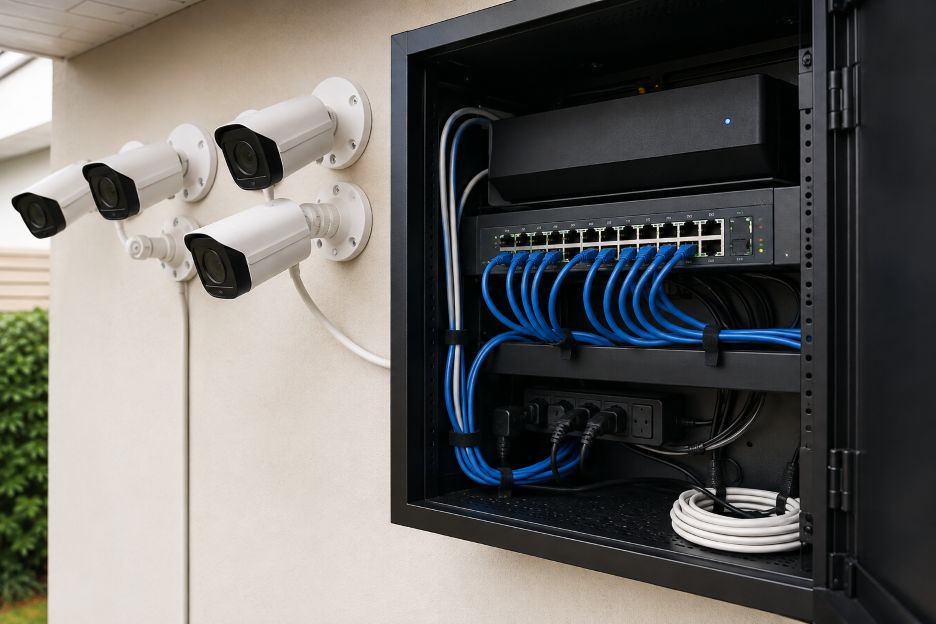
A modern CCTV system has four core components: cameras, a network video recorder, network switches, and cabling. The cabling carries data and, in many systems, electrical power. Each component has a distinct role, but reliability depends on how well they work together.
For homeowners considering CCTV installation Peterborough, understanding the hardware is important. Camera count alone does not determine the quality of a security system. Other factors also affect performance. These include resolution, storage capacity, network bandwidth, power availability, cable routes, and recorder compatibility. Together, they determine how effectively the system captures and retains footage.
Cameras Are the Starting Point
Network, or IP, cameras turn images into digital video that can travel across an Ethernet network. Unlike traditional analogue cameras that send video signals to a separate recorder for processing, IP cameras have computing hardware. They can encode video before transmitting it.
Axis Communications’ technical documentation shows network cameras use RJ45 Ethernet. They can receive Power over Ethernet, or PoE. Depending on the model, cameras may also support features such as microphones, digital inputs, alarms, motion detection, infrared illumination, or connections to external sensors.
Resolution is important, but it is only one factor when choosing cameras. Frame rate, lens characteristics, low-light performance, viewing angle, compression settings, and mounting position can all affect the usefulness of recorded footage. A very high-resolution camera placed at the wrong angle may provide less useful evidence than a carefully positioned lower-resolution unit.
What Does the NVR Actually Do?
The network video recorder, usually called an NVR, acts as the central recording point. It receives video streams from compatible IP cameras, manages recordings, and stores footage on internal hard drives or other supported storage devices.
An NVR may also provide the interface used to search recordings, configure schedules, manage users, and display several cameras simultaneously. Some recorders include built-in PoE ports, allowing cameras to connect directly to the recorder rather than through a separate switch.
Documentation from Axis Communications illustrates how recorder specifications can impose practical limits. Its AXIS Companion Recorder 4CH, for example, supports PoE for up to four cameras and has a defined total power budget. The example demonstrates why installers need to consider electrical demand as well as the number of available network ports.
Storage deserves similar attention. Higher resolutions, longer retention periods, higher frame rates, and continuous recording generally create more data. Video compression can reduce storage requirements, but property owners still need to plan capacity based on how they intend to use the system.
Why PoE Switches Matter
A PoE switch combines two jobs. It moves network traffic between connected devices while supplying electricity to compatible cameras through Ethernet cabling. That means one cable can provide both the data connection and power needed by a camera.
Technical guidance from Axis Communications explains that network cameras, wireless access points, and IP phones widely use PoE. Centralized power can simplify camera installation because installers do not necessarily need a separate electrical connection beside every camera.
There is an important limitation, however. A PoE switch has a finite power budget. Each connected camera consumes part of that capacity, and features such as heaters or infrared illumination can change power requirements. Current Axis guidance recommends accounting for maximum camera consumption and losses in Ethernet cabling when estimating the required power capacity.
This becomes particularly important in larger systems. Having enough physical ports does not automatically mean a switch has enough electrical capacity to operate every attached device under demanding conditions.
Cabling Is More Than a Connection
Ethernet cabling provides the physical path between cameras, switches, and recorders. Network installers commonly use Category 5e, Category 6, and related cable standards. However, they choose the appropriate cable based on network performance requirements, environmental conditions, distance, and equipment specifications.
Axis Communications notes that factors including cable quality, conductor thickness, connectors, and camera power consumption can influence performance. Its technical material also recommends a maximum conventional network cable distance of 100 meters between certain network components before installers consider specialized extension equipment.
Cable routing matters as well. Guidance published by Axis Communications on electrical surges recommends avoiding routes parallel to power lines where possible and discusses shielded cabling, grounding, and surge protection for installations exposed to electrical disturbances. Outdoor camera runs may require additional consideration because cables and devices can be exposed to weather and electrical surges.
How the Components Work Together
Once connected, the hardware forms a chain. A camera captures and processes an image. Ethernet carries its video data through a switch or directly to an NVR. The recorder receives and stores the stream, while the network provides access for authorized viewing devices.
A weakness anywhere in that chain can affect the overall result. Insufficient network capacity may interrupt streams, inadequate storage can shorten retention time, an undersized PoE supply can create power problems, and poor camera placement can leave important areas outside useful coverage. Similar considerations apply to computer hardware used in modern investigations, where the ability to process, store, and retrieve digital information can influence how effectively technical evidence is handled.
Cybersecurity also belongs in the hardware discussion because IP cameras and recorders are network-connected devices. The National Institute of Standards and Technology has emphasized the importance of understanding the expected network behavior of Internet of Things devices so appropriate access controls can be applied. Cameras and recorders should therefore be treated as network equipment rather than isolated appliances.
Hardware Planning Determines the Finished System
A dependable CCTV setup is ultimately a coordinated network of cameras, recording hardware, power equipment, storage, and cables. Choosing individual components without considering their combined requirements can lead to unnecessary limitations later, particularly when additional cameras or longer recording periods are required.
Professional security camera installation normally involves matching camera capabilities with suitable recording capacity, network infrastructure, PoE availability, and physical cable routes. Getting those fundamentals right creates a system that can capture, transport, store, and retrieve footage consistently, while leaving sensible room for future changes.
Tags: CCTV Systems, Security Cameras, Network Video Recorders, PoE Technology, Home Security
Image Prompts
1. Realistic editorial photograph of a modern home CCTV installation showing several IP security cameras connected to a network video recorder and PoE switch, Ethernet cables neatly organized in a small equipment cabinet, professional residential setting, natural lighting, no logos or readable text.
2. Realistic close-up photograph of a technician connecting Cat6 Ethernet cables to a PoE network switch beside a CCTV network video recorder, organized security equipment rack, detailed cabling visible, professional lighting, no logos or readable text.
3. Realistic editorial photograph of an outdoor IP security camera mounted on a British residential property, Ethernet cable being routed discreetly into the building by an installer, overcast natural daylight, realistic home-security setting, no logos or readable text.